Nairobi, August 2025
Rising above the East African landscape, Mount Kilimanjaro is more than a majestic landmark. As Africa’s highest peak and a UNESCO World Heritage Site since 1987, it serves as a vital water tower for millions across Tanzania, Kenya, and beyond. To raise awareness of the threats facing this iconic mountain, a 50-climber exploration mission supported by UNESCO will be launched in the coming days.
From 4 to 10 August 2025, a diverse team of 50 climbers—comprising youth from Tanzania, Kenya and the United States, alongside scientists, United Nations experts, and private and public sectors representatives—will ascend Kilimanjaro in a rare blend of science, advocacy, and intergenerational action. The expedition is led by world-renowned polar explorer Børge Ousland and Kilimanjaro Initiative Founder Tim Challen, both members of The Explorers Club.
“This climb is about more than reaching the summit,” said UNESCO Director-General Audrey Azoulay. “As we join hands with the Explorer Club and young representatives from three countries to ascend this mountain, we send a clear message from the roof of Africa: the time to act is now. With science as our compass, the international community must unite to protect our glaciers. This is what the International Year of Glacier Preservation, led by UNESCO and the World Meteorological Organization, is all about.”
The climb marks a key moment in the International Year of Glaciers’ Preservation (2025), a UN-declared effort to spotlight the dramatic retreat of the world’s glaciers and its consequences. Mount Kilimanjaro is one of the most striking examples: its glaciers are shrinking, its forests receding, and with them, threatening water security, biodiversity, and livelihoods of entire communities.
But this is not just a symbolic climb—it is also a data-gathering mission. Participants will carry out environmental research along the ascent, collecting data on water contamination, vegetation stress, and ecosystem health. These efforts will directly support UNESCO’s Kilimanjaro Transboundary Aquifer System Programme, a $8 million project launched in March 2025 by Director-General Audrey Azoulay in Dar es Salaam. Funded by the Global Environment Facility (GEF), the initiative promotes sustainable groundwater management, stronger climate resilience, and improved water access across the Tanzania-Kenya border region.
The stakes are high. Since 1912, Mount Kilimanjaro has lost 85% of its glacial ice and over 30% of its forest cover, according to researchers from the University of Dodoma. This environmental degradation has intensified droughts and undermined local ecosystems, placing growing strain on ecosystems and on local populations—especially women, who bear the brunt of water scarcity and climate-related displacement. Researchers from the University of Dodoma and the University of Geneva will accompany the group on the ascent of Mount Kilimanjaro.
The climb combines cutting-edge science, community-driven action and youth membership.
QUOTE FROM RICHARD WEISE, PRESIDENT OF THE EXPLORERS CLUB
“There is perhaps no greater symbol of our changing climate than the snows of Kilimanjaro. Since I first summited in 1971, and on 18 subsequent climbs, I’ve witnessed firsthand the retreat of its glaciers and the growing fragility of this once timeless landscape. This climb represents more than a physical ascent—it’s a call to action, uniting science, youth, and global collaboration to protect what remains and inspire what must come next.”
QUOTE FROM EUNICE PENETI, TEAM LIONESS RANGER IN AMBOSELI, KENYA
“As a young Maasai girl, I led a semi-nomadic life within the Amboseli basin at the foot of Mount Kilimanjaro. We moved around in search of water and greener pastures – during droughts I would miss school as we had no income at all. I know work as a ranger, within a female only team. Our objectives are to help avoid wildlife-human conflict, poaching, and work with our communities to protect our environment. I believe the climb will help make new connections, share knowledge, and teach me leadership skills.
QUOTE FROM CALVIN MTUI, STUDENT FROM MARANGU, KILIMANJARO
“I grew up at the foot of Mount Kilimanjaro and have always been fascinated by its energy. My father is a tour guide, and our family heavily depends on his seasonal income. I want to work in the hospitality industry, to showcase our beautiful mountain. But without the ice and snow, I wonder what impact it will have on local tourism. The place where I grew up will no longer look the same.”
QUOTE FROM TIM CHALLEN, PRESIDENT OF KILIMANJARO INITIATIVE AND CLIMB ORGANIZER.
“After being shot and severely injured during an armed robbery in Nairobi I realized that communities must work hand-in-hand with the private and public sectors to engage and support youth. This climb exemplifies this approach. Mt Kilimanjaro is a water tower that serves millions of people. The mountain is drying up. Together we need to highlight challenges and collaborate towards solutions, empowering future generations through sustainable means.”
QUOTE FROM BØRGE OUSLAND, POLAR EXPLORER AND FOUNDER OF ICE LEGACY
“To educate our children about outdoor life and resilience, teach them about nature, give them challenges, that’s one of the most important things we can do. I am happy my daughters are joining me on this expedition.”
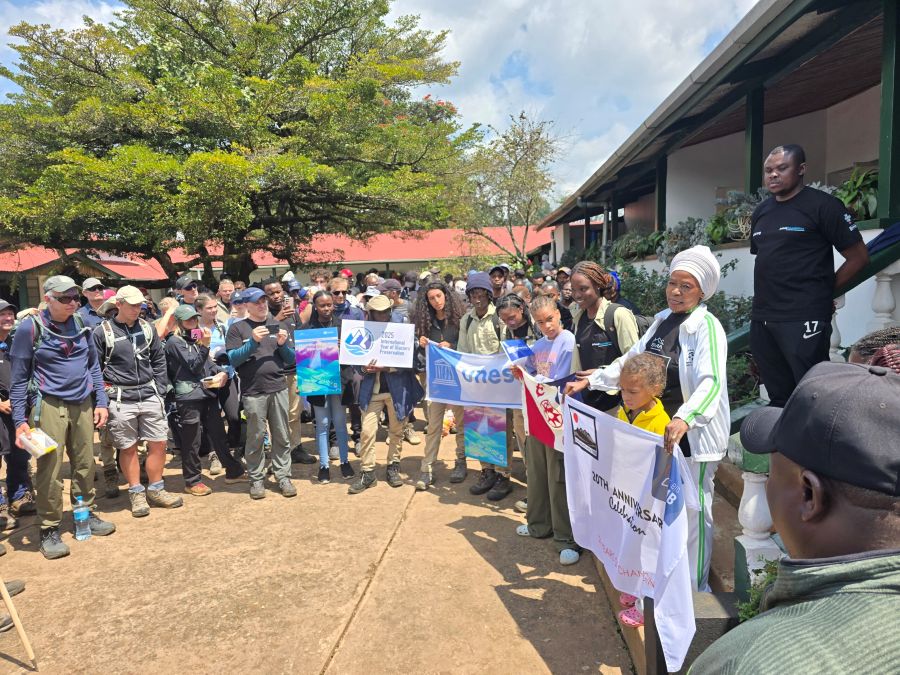
Photo: Climbers and their support crew at start of climb, flagged off by Professor Anna Tibaijuka, former Executive Director of UNHABITAT, and Keven Robert Makooko, UNESCO National Programme Officer in Tanzania.
For more information
Web: www.kiliunited.org
Instagram: @the.big.climb